Round folding table sizes follow three working formats: a compact 86 cm diameter top at 74 cm height, plus 60 in (152 cm) and 72 in (183 cm) round tops for banquet seating. Therefore, a distributor who stocks all three covers café terraces, family patios and full banquet floors with one product family. This guide compares the three formats, the freight math behind each, and the spec lines to confirm before you order.
What Are the Standard Round Folding Table Sizes?
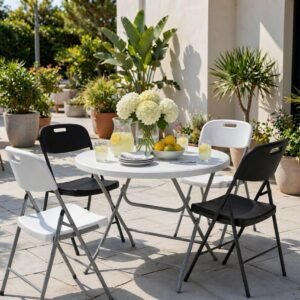
Suppliers generally build round folding tables in three diameters. At SKYFOLD® — Shandong Senrui Home Co., Ltd. — Linyi, Shandong, China — backed by Chanta Group — the standard round line starts at 86 × 86 × 74 cm and extends to 60 in and 72 in round tabletop formats. Moreover, all three share the same folding steel understructure, so your customers see one consistent product story across the range.
The 86 cm format is the workhorse for small spaces. In addition, because it folds flat and carries a built-in handle, it stores in a retail box on a single shelf. Meanwhile, the 60 in and 72 in tops target the banquet and rental segment, where round tables remain the default for weddings and gala seating.
| Format | Diameter / size | Height | Typical seating | Best channel |
|---|---|---|---|---|
| 86 cm round | 86 cm diameter | 74 cm | 2–4 guests | Retail, patio sets, cafés |
| 60 in round top | 152 cm diameter | 74 cm | 6–8 guests | Banquet rental, hotels |
| 72 in round top | 183 cm diameter | 74 cm | 8–10 guests | Wedding and event rental |
How Many Guests Does Each Round Folding Table Size Seat?
Seating is the first question your buyers ask. As a rule, an 86 cm round comfortably serves two to four guests, which is why café and patio buyers lead with it. Similarly, a 60 in top seats six to eight, and a 72 in top seats eight to ten at standard place settings. Consequently, a rental operator can plan a 200-guest wedding floor with 25 × 72 in tables instead of 40 smaller units.
However, seating counts assume standard 45 cm per-place width. For example, trade buyers who expect larger service displays should step one size up rather than overfill the smaller top. Likewise, pairing the round line with folding chairs from the same supplier keeps the seat-to-table ratio consistent across an entire fleet.
Round vs Rectangular: Where Each Format Wins
Rectangular tables still dominate volume, and for good reason. An 8 ft rectangular table feeds buffet lines, trade shows and long banquet rows, as shown in our top 5 use cases for 8ft tables. Nevertheless, round formats win where conversation and floor flow matter: café terraces, showrooms and wedding reception floors all move better around a circle.
For distributors, the commercial logic is simple. Rounds carry higher perceived value per unit in the event segment, so they defend margin. Furthermore, because round tops use the same HDPE blow-molding process as rectangular panels, you can consolidate both formats in one container and one supplier relationship.
How Do Round Tops Change Container Loading and Freight?
Freight is where round folding table sizes deserve a closer look. Since round tops cannot nest edge-to-edge like rectangles, they consume more cube per unit. As a result, we recommend that buyers confirm exact stacking dimensions and loaded quantity for each diameter before calculating landed cost, rather than extrapolating from rectangular data.
Production capacity is not the constraint. SKYFOLD produces more than 5,000 HDPE tabletops per day across six outdoor furniture lines in a 10,000 m² factory equipped with 13 large blow-molding machines. Consequently, a mixed container of rectangular and round formats ships within the standard 30-day window for a 40HQ order. Additionally, buyers can read how blow-molded panels perform in retail channels in our blow molded tables for e-commerce and retail guide.
What Should You Verify Before Ordering Round Tables?
Three spec lines matter most. First, panel construction: every SKYFOLD round top is blow-molded from HDPE with 40% virgin and 60% recycled resin, and the folding legs use 22 × 1.0 mm seamless steel tubing with a powder-coated, phosphate-treated finish. Second, load and stability: the 86 cm round carries a static load of 150 kg or more, and panels are tested to EN 581-1:2017 and EN 581-3:2017 at domestic use level under the CEN framework (cen.eu). Third, hardware: lock clasps and horseshoe-shaped buckles should lock the legs positively, because a round top hides a loose leg less gracefully than a rectangular one.
Corrosion and finish details also deserve attention. For instance, our anti-glare and anti-rust engineering article explains why the steel understructure, not the top, determines outdoor service life. Therefore, ask any supplier for the tubing spec and surface treatment in writing before you commit.
Frequently Asked Questions
What is the most popular round folding table size for rentals?
The 60 in (152 cm) round is the rental standard for banquet work, because it seats six to eight guests while still fitting typical venue aisles. However, wedding-heavy operators usually add 72 in rounds for head tables and premium layouts.
Can one container mix round and rectangular folding tables?
Yes. Because both formats share the same blow-molding process and leg system, a 40HQ can mix three to four models, and SKYFOLD confirms the split quantity in the loading plan before production starts.
Do round folding tables use the same HDPE panel as rectangular ones?
Yes. The round tops use the identical HDPE formulation and blow-molding line, so color, surface texture and weather behavior match the rectangular range your customers already know.
Ready to build a round table program? contact the SKYFOLD team for round folding table sizes in 86 cm, 60 in and 72 in, a loading plan for your market, and a sample set before you book the container.