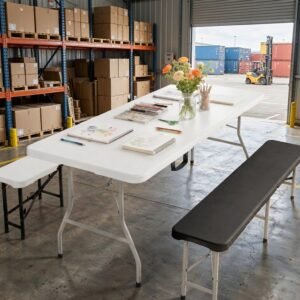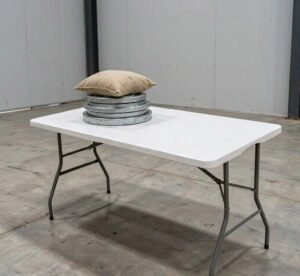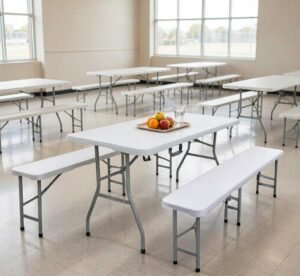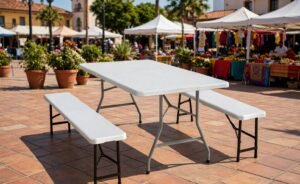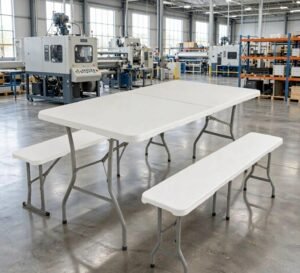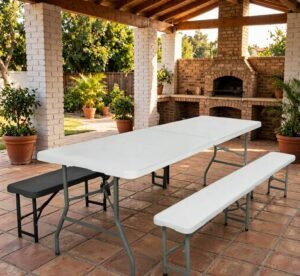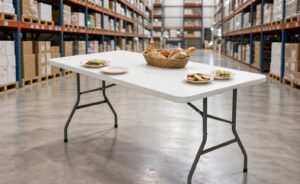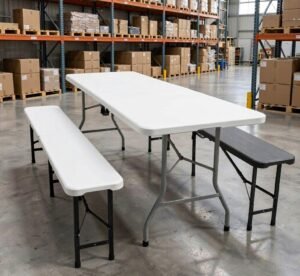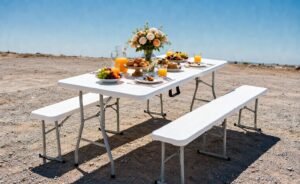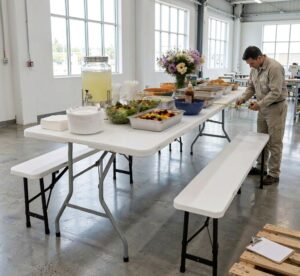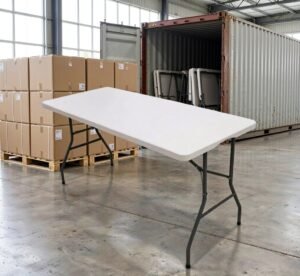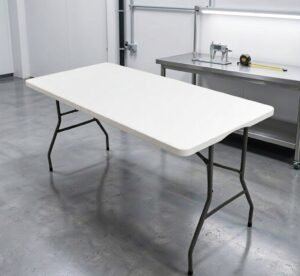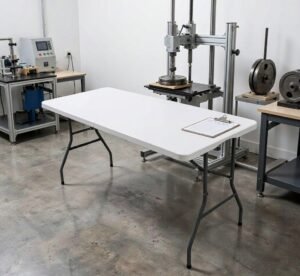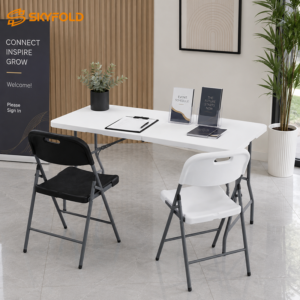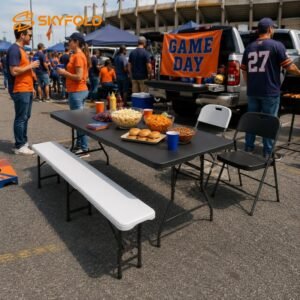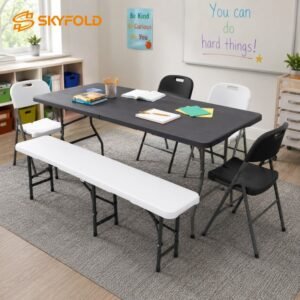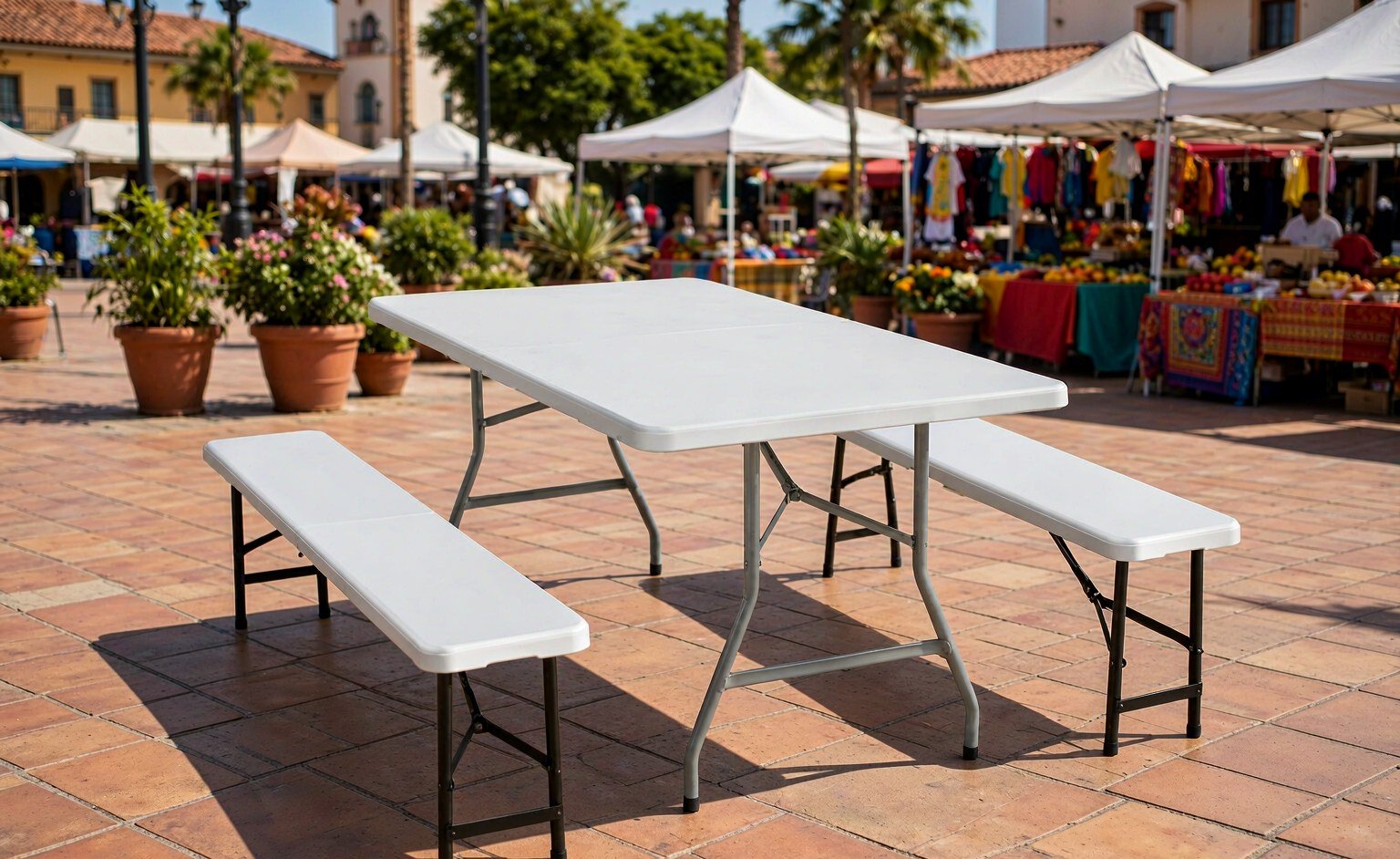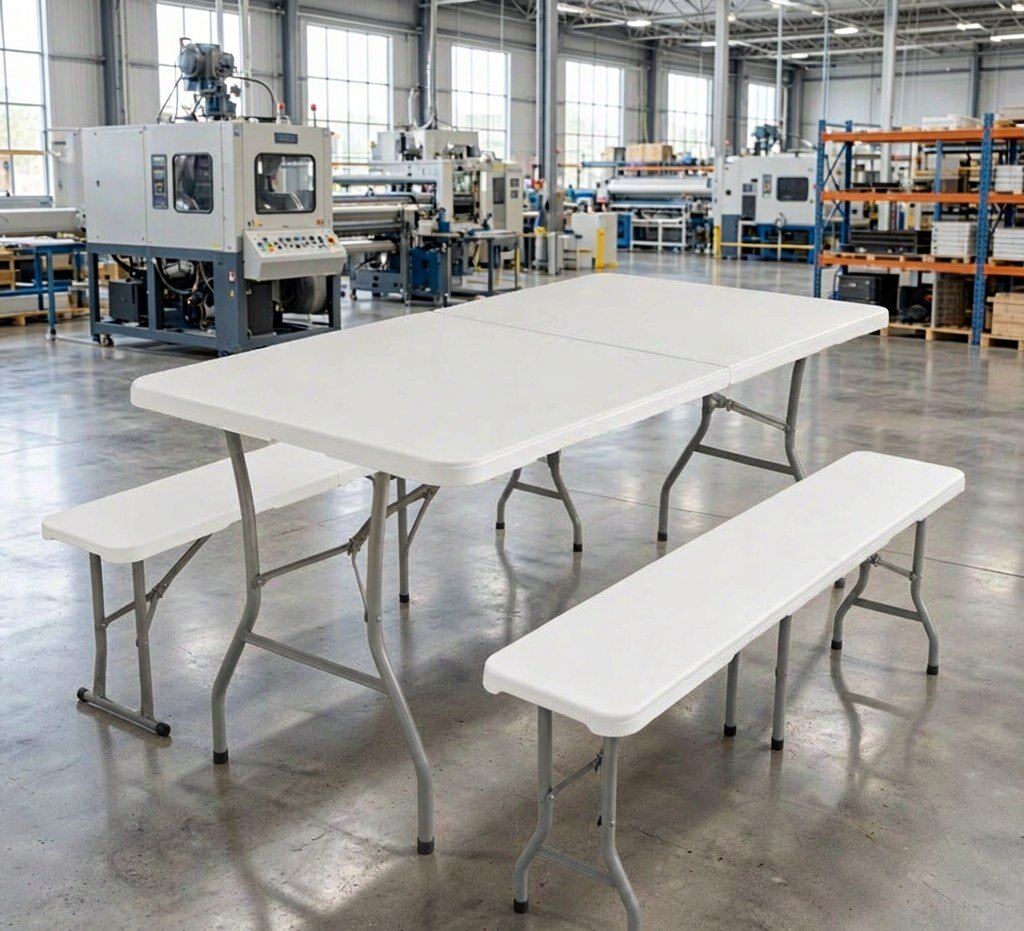
A folding table weight capacity of 150 kg describes a static vertical load, applied with the legs fully locked and the weight spread across the centre of the top. Therefore, the number on a spec sheet means little without the test method behind it. At SKYFOLD, every 6 ft HDPE model carries a 150 kg+ static load rating, verified through EN 1730 test methods under EN 581-3:2017 at domestic use level.
This guide explains what the rating covers, how the laboratory proves it, and which spec lines confirm the number before you order.
What Does a 150 kg Rating Actually Mean?
Firstly, a static load rating is not a jumping, dragging or point-load figure. The 150 kg assumes distributed weight — for example, catering trays and tableware rather than a person on one corner. Secondly, the rating applies to the complete table: HDPE top, steel frame and locking hardware working together.
As a result, a stiffer top cannot compensate for a weak hinge, and vice versa. Moreover, the environment matters: HDPE panels keep their strength from -60°C to 80°C, so a table holds the same rating on a frozen dock as under summer sun.
Which EN 1730 Tests Prove the Number?
EN 1730:2012 defines the test methods behind EN 581-3, the European standard for table mechanical safety (see CEN for the standard family). Under EN 581-3, a laboratory applies four relevant checks: a vertical static load on the main top, an additional vertical load for tops longer than 1,600 mm, horizontal fatigue loading, and stability under vertical load. Consequently, a 180 cm top such as ours must pass the extra load test that shorter tops skip.
Our evidence is public: report EFBH25100354-CG-01, issued by Eurofins on 24 October 2025, covers sample DS-CZ180 against EN 581-1:2017 and EN 581-3:2017 at domestic use level. In fact, we state the domestic use scope deliberately, because a report without a declared test level tells you nothing about duty cycle. Therefore, ask any supplier for the report number, the laboratory name and the test level — in writing.
Where the Strength Comes From: Panel and Frame
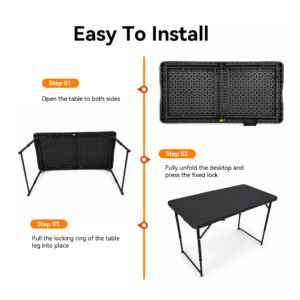
Each SKYFOLD 6 ft top uses a blow-molded HDPE panel — 40% virgin and 60% recycled resin — over 22 × 1.0 mm seamless steel legs with a 1.0 mm wall. The legs receive acid pickling, phosphating and outdoor powder coating, so rust never gets a head start on the load path. Furthermore, a horseshoe-shaped buckle locks each leg, and a lock clasp reinforces the folding joint.
Production consistency matters as much as design. SKYFOLD® — Shandong Senrui Home Co., Ltd. — Linyi, Shandong, China — backed by Chanta Group — runs 13 large blow-molding machines across two self-owned factories and moulds more than 5,000 table tops per day. As a result, the panel that passed the laboratory test and the panel inside your container come from the same tooling and resin batches.
Which Spec Lines Should You Compare?
Because the folding table weight capacity depends on panel stiffness and frame wall together, compare thickness and weight side by side instead of trusting a single “heavy duty” label. The table below shows how our 6 ft range trades loading density for reinforcement. For example, the Premium models add half a centimetre of frame thickness and about one kilogram of net weight, which lowers 40HQ loading from 1,300 to 1,100 pieces.
| Model | Panel frame thickness | Net weight | 40HQ loading |
|---|---|---|---|
| SF-180 Standard | 3.5 cm | 10.0 kg | 1,300 pcs |
| SF-180 Custom Heavy | 3.7 cm | 10.5 kg | 1,240 pcs |
| SF-180E2 Premium | 4.0 cm | 11.1 kg | 1,100 pcs |
| SF-180F2 Premium | 4.0 cm | 11.1 kg | 1,100 pcs |
Read the rows as a stiffness ladder rather than a price ladder. Nevertheless, net weight alone can mislead: a hollow top with thin walls can weigh the same as a reinforced panel. For pairing tables with seating, our heavy-duty folding benches and the round table hospitality ROI guide apply the same logic across a full set.
From Lab Report to Every Shipment
A certificate covers one sample; an inspection covers your order. Therefore, every SKYFOLD shipment leaves with a PSI inspection report built on AQL Level II sampling — Critical 0, Major 2.5, Minor 4.0 — plus factory QC video from both the panel and assembly stages. Our B2B quality control standards article documents the full chain from resin intake to the loading bay.
The scale behind that paperwork stays constant: two self-owned factories, 10,000 m² of workshop and six outdoor furniture production lines. Meanwhile, standard 40HQ orders ship within 30 days, so your report and container share one production window. For Spanish-language buyers, we summarise the same programme in our Spanish guide.
Does a heavier folding table always hold more weight?
No. Weight is only a proxy; the load path — panel stiffness, tube wall, hinge and lock — decides the rating. Consequently, compare the test report and frame specification first; treat net weight as a secondary signal.
Is the 150 kg rating per table or per seat?
Per table, under a static and distributed load. Place the weight across the centre of the top with the legs fully locked, and the structure holds 150 kg+. A point load on one corner exceeds the design intent of any folding table, whatever the brand claims.
Which documents should I request before ordering?
Request three: the EN 581-1 and EN 581-3 report with its number and test level, the PSI template with AQL levels, and the spec sheet showing tube wall and panel thickness. With those documents, the rating becomes a checkable fact instead of a marketing adjective.
Get the Test Report Before You Commit
Send us your target specification, and we will send back the folding table weight capacity report EFBH25100354-CG-01, a sample PSI file and a quote for your first 300-piece order within one working day. Moreover, every 40HQ order includes free logo application, 10–20 spare cartons and a design-services package sized to your container count.